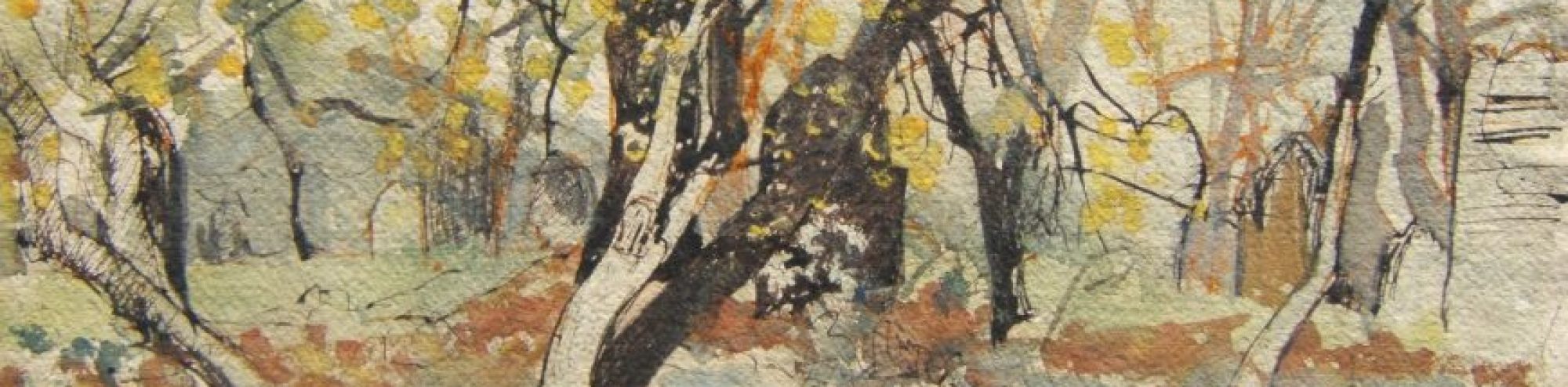
NB: **DENOTES A DIRECT ANCESTOR OF MINE IN THIS TEXT.
I always knew that my mother, **Denise Clur nee Barker’s descendants were from Northern England, but had never visited that area myself. As I had previously completed several successful genealogically inspired road trips, I decided to add a few days on to my stay when arranging to attend a workshop in Leeds. I wanted to trace the footsteps of my maternal ancestors who had inhabited North Yorkshire and County Durham many years ago. Wilfried, my faithful co-pilot on all my previous trips, was enthusiastic and looked forward to accompanying me once again. I had done some pre-research and made a map showing the residential origins of many of my mother’s family and hoped to visit as many of the relevant places as possible.


All photographs: copyright of Sally-Ann Clur or Wilfried Visser
Sunday 29th June – Monday 30th June 2025 – Hazlewood Castle
It had been unusually hot for the last days of June. Waiting in the plane at Schiphol for clearance to take off was particularly uncomfortable. I was not suitably dressed for the warm weather and the perspiration rolled down my cheeks as we baked in the enclosed space of the plane. The flight itself was without incident and soon we were landing at Leeds airport. Once landed and through passport control and customs, the next step was to pick up our rental car. We hiked through seemingly endless parking lots in the full sun to get from the terminal building to the car rental center. Once installed in our rental vehicle, we set off excitedly for Hazlewood Castle Hotel. For the next two days I participated in a fetal cardiac magnetic resonance imaging workshop while Wilfried was left to enjoy the surroundings and soak up the history of the castle that was the home of the Vavasour family for more than 800 years.
I was most impressed by the little St. Leonard’s Chapel, built in 1286, and the Flemish Hall. The Chapel was opened on my request to take a look inside. This took some effort as the old wooden door is still locked with the original big metal key, and the lock turned with some difficulty. From inside, the lovely stained glass windows could really be appreciated. Confetti from a previous marriage still lay scattered on the red carpet. In the courtyard adjacent to the Chapel the graves of several Vavasour family members could still be seen. There was also a tribute to Vera Taylor 1921-2003 a midwife who delivered many babies at Hazlewood Castel when it was a maternity hospital from 1939 and 1953.


The walls of the Flemish Hall are adorned with 17th century wooden carvings that originated from a Carmelite Church in Gent. The stone carvings above the fireplace depict Jezebel being thrown from the castle top, whereafter the flesh of her corpse would be devoured by stray dogs. Several Madonna figures can be seen in the Castle grounds and on the hotel walls, all attesting to the Catholicism of the Vavasour family. When photographing the painting by Anita ?Bowceman that hangs near the reception, a reflection of the chandelier appeared in the picture, looking like an elaborate halo above her head.


When King Henry VIII appointed himself as Head of the Church of England (1534) and traveled north to arrest the Archbishop of York and take him back to London for execution, the Vavasour family offered him accommodation at Hazelwood Castle. King Henry declined, but this gesture probably saved the Vavasour family. King Henry then ordered that the Vavasours be left in peace and prohibited desecration of the St Leonard’s Chapel. In 1560 Ann Vavasour became the lady in waiting for Queen Elizabeth 1. However, when Ann gave birth to Edward Vere a year later, fathered by the Duke of Oxford out of wedlock, both the Duke and Ann were placed in the Tower of London for punishment.

Photographs Sally-Ann Clur © 2025


Peacocks, including an albino, roam free in the castle grounds and their distinctive call could be heard in the mornings. The most vocal of the birds however, were the blackbirds. We were treated to a blackbird serenade from the rooftop during our first dinner in the open air. The duck was delicious and the Vavasour Pinot Gris excellent. After dinner I tried to sleep but the temperature was prohibitive. At 3:30 the next morning, when eventually asleep, the blackbirds awoke me with their song. The dawn was just breaking on the horizon manifesting a purple-orange streak, behind the line of trees behind the Chapel. Above the window sparrows were busy making a nest.


Tuesday 1st July 2025 – Whixley
Our stay at Hazelwood Castel was very pleasant. We had enjoyed the Vavasour wine, good company at a Harry Potter theme evening event plus the workshop was most informative and productive. After lunch we set off north, stopping first at Whixley in search of Daniels. **Hannah Daniel married **William Robinson and their daughter **Elizabeth married **Osmond Barker, my great, great, grandfather.
We drove along Church Road and found the Whixley Ascension Church at the end of a cul de sac and up a narrow lane. If we had not known it was there, I don’t think we would have realized that behind the houses a church and graveyard were hiding. The entrance was charming with a pathway leading up to the church. On the right side of the path I immediately encountered several old Daniel gravestones. The first one was of Jane Daniel only daughter of Andrew and Francis Daniel of ?Stockfeld Lodge, who died March 26th, 1836, aged 14 years. The inscription on her gravestone attests to her youthful character; “Lately we saw her here; amongst the social band; How with bow blithe did she appear; not so it seemed here; Oh youth … to time, make God an easy friend; to him devote your blooming prime; Then peace shall be your end.” The oldest Daniel I found in the churchyard was Thomas (1745-1817) who was buried with his wife Elizabeth (1751-1837). Several of the gravestones can be seen at The Daniel(l)s of Whixley 1540 – 1860.


Photographs: copyright Sally-Ann Clur 2025
In the front of the church the lawns were attended and negotiating between the graves was no problem. However the rest of the graves, especially those behind the church, had been left to nature. At the entrance to the churchyard there was a sign saying that it was now a sanctuary for wildlife. Many plants that flourish in old churchyards are becoming rare in the countryside and for insects, birds and small mammals these churchyards are a haven. Areas are deliberately left unmown, until the plants have seeded and when mown the grass is raked into piles which provide shelter for many creatures. This meant that to get to many of the old graves we had to fight through the thistles, brambles and stinging nettles. I was dressed in a short skirt and sandals, so by the time we left the church, I had burning, red ankles and legs with small itchy welts all over them. Funnily enough the word urticaria means “nettle” and is derived from the botanical name for the stinging nettle plant – Urtica doica of the family Urticaceae. That night when I got up to visit the bathroom my feet felt like they were floating in a sea of water and my left ankle was still swollen and strangely sensitive. I had received a royal dose of stinging nettle poison! Despite the discomfort of the stings, the plants have medicinal qualities, including antioxidant, analgesic and anti-inflammatory properties. Wilfried said that having experienced this, a tangible connection has now been made between the earth where my ancestors remains lie and myself, such that I not only share some of their DNA but also some of their atoms!


Photographs: copyright Sally-Ann Clur 2025
Behind the Church on the left side when looking up the hill, there is another group of Daniel and Kettlewell graves, (Mary Daniel married Richard Kettlewell in 1769). Many Daniel graves are under a tree along the fence separating the churchyard from a foot path leading to a second graveyard with more recent graves where I found more Kettlewells and Bensons, (George Benson married my great, great, great, grandmother Hannah Robinson, nee Daniel’s sister Mary). I tried to get a careful look at all of the Daniel graves but by that time I was struggling with the pain in my legs and took quick pictures of as many as I could see and reach. I imagine that I have missed some and the inscriptions were not always completely legible. Especially poignant was the grave of Thomas Daniel and little Thomas, John and William who had died in infancy; and that of William Daniel who died aged 23 years, two years after his wife Annie and 3 month old daughter Elizabeth Annie died. In the middle of the back churchyard area there was also the grave of Charlotte, wife of William Barker.

On the right the gravestone of “John Daniel of Whixley who departed this life December 29th 1860 aged 82 years (born 1778), Also of Sarah his wife who died September 9th 1868 aged 80 years, (born 1788)” Photographs: copyright Sally-Ann Clur 2025

Wilfried has an insatiable curiosity, he must have driven his mother crazy always touching and exploring things to discover how they work. He naturally tried all the doors of the Church and even managed to find a way in using the reverend’s entrance. Seeing the interior of the church provided a wonderful conclusion to an exceptional experience in Whixley.


Wednesday 2nd July 2025 – Sedgefield
Somewhat overwhelmed by the success of our first day, we travelled north from Whixley to spend the night at Redworth Hall Hotel. This “17th-century Manor” was described as “a magnificent Jacobean mansion converted into an opulent hotel”. This, and its location in Newton Aycliffe had caught our eye. Despite the vast grounds and grand external appearance, one could not help feeling that it may have just got too big for its boots. When arriving at the fourth floor the lift announced that we were at the third, the delux spa bath was old and weathered, and the drawers in the cupboard were broken. There was very little daylight in our room and the window was kept open by a glass precariously balanced between the window frame and the window. There was a strange elevated “noekie” (small enclosed area) in front of the window with a small couch in it that could be closed off from the rest of the room when the curtains were drawn. From the couch one had a direct view of the bed, as if it was intended for a voyeur. The air conditioning was continuously on, non- adjustable, and too cold. Naturally, Wilfried could not resist fiddling with it, and managed to turn it off after climbing on a chair and pressing a button just below the ceiling.
Redworth Hall Hotel is located near Staindrop, Field House, St. Helens Auckland where **Jane White‘s (1746 -1817) family came from. She married **Henry Valks (1736-1809), a weaver. Their daughter **Ann Vaulks (born 1765) married **Robert Barker (born 1769) of Sedgefield, my great, great, great, great grandfather. So the next morning we set off in search of St. Edmund’s Church in Sedgefield. Wilfried entered the address in the car navigation, enjoying negotiating the workings of a new electronic device. I looked up the location of the Church on Google Maps on my telephone. When we arrived at the gate of the hotel, the navigation said go left, and my phone said go right. With implicit trust in the car’s navigation system and disdain for all Apple products, Wilfried turned left. My phone showed that we would be making a detour, maybe to avoid an acute traffic problem that my phone was not aware of, and anyway, many roads lead to Rome…


After some time, I looked up and saw a sign “”New Brancepeth“. I was amazed, that was where **John Sharp (1770 – 1832) came from. He was another of my great, great, great, great, grandfathers and father of **Eleanor Sharp (1814 – 1888) who married **Joseph Barker (1809 -1884), son of **Robert Barker. We had been brought there, it seemed, by divine intervention. A short while later we arrived at St. Edmund’s Church Bearpark. We had unwittingly driven north almost to Durham instead of east to Sedgefield. Once there however, we decided to explore the churchyard. Here too the old gravestones had been left unattended and were overgrown. There was a nice path leading you to the old graves that was covered in trees overgrown with ivy making it cool and quiet. This time I was prepared, I had jeans and running shoes on. It had rained the night before, and despite all my preparations, I was soon walking in wet socks and squishy shoes as the water soaked through the airholes in my running shoes! Not surprisingly, we did not find many relevant graves there, having arrived at the wrong church. However, I did find an Urwin and a Pearson (my father’s mother’s maiden name) gravestone. The Pearsons came from Berwick-on-Tweed (see The Pearsons of Woolwich and Berwick-upon-Tweed.) Robert Barker‘s (born 1769) parents were **Joseph Barker senior and **Jane ? Irwin of Sedgefield.
Later that day we did eventually manage to find our way to the correct St. Edmund’s the Bishop Church in Sedgefield. There we found a grand church on a hill, across the road from the pink “Impeccable Pig” restaurant and hotel. The first church, most likely of wood, was built between AD 900 and 915. Normans, former Vikings that had settled in northern France, invaded England in 1066 led by William the Conqueror, who claimed the English throne. The later church erected after the Norman Conquest would probably have been built in AD 1085 using stone. The present church was built between 1246 and 1256 with the tower being added in 1490. It was dedicated to St. Edmond the Bishop – Edmund Rich, Archbishop of Canterbury. I remember visiting the Bayeux Tapestry in France with my very excited mother Denise Clur nee Barker, several years ago. It depicts the events leading up to the Norman Conquest. I have had my DNA analyzed and I have a significant amount of Viking DNA, maybe from the Normans?


Nancie McDougall’s (granddaughter of Osmond Barker ) notes said the tombstone of the Vaux/Vaulks/Valks family grave is at the church, but I did not find it. It would have dated back to 1799, so it may no longer be legible or may have fallen over. However, when walking from the church back along the path towards the gate, I passed the gravestone of a John White (?1798 – 1860) and his wife Ann (1786 – 1856) on the right. I wondered if these could be family of ‘my’ Jane White (1746 -1817), who married Henry Valks/Vause (1736 -1809). The closest we came to finding a Vaux/Valks/Vaulks/Vause grave was one of a Voks. Considering how the name has changed over years, who knows, maybe these were relatives. The grave was in the new cemetery located on Butterwick Road. We also came across several Robinsons and a few Barkers. Tired, and a bit disappointed, we chose to have supper at “The Pickled Parson” near the church. There we contemplated possible things the pickled parson did in order to have a restaurant named after him, before making our way back to the Hotel.


On the left the Valks family grave at St Edmund’s the Bishop, Sedgefield. De gravestine is inscribed:- “Here lieth the Body of William Valks who died March 18th 1736 Aged 1 month. Also Here lieth the body of ANN VALKS who died Feb 7th 1757 Aged 16 Also here lieth the body of DOROTHY wife of HENRY VALKS who parted this life November 24 1772 aged 66″
Thursday 3rd July 2025 – Wolviston and Billingham
The next morning we set off for Wolviston and Billingham. My great, great, great, grandfather Joseph Barker (1809 -1884 ) – son of Robert Barker (b1769) and Ann Vaux – was a blacksmith in Wolviston. He married **Eleanor Sharp (1814 – 1888). The 13th of their 16 children, Osmond, my great, great grandfather, was also a blacksmith and occasional preacher. The pulpit of St Peter’s Church was erected where his anvil had been.
Together, Joseph and Eleanor, or should I say mostly Eleanor, also ran the village post office. Wolviston is a charming village. Flowers adorned the doors of almost every house in High Street where the current post office is located. On the corner of Durham Road and High Street the old Wellington Inn is located. I could imagine my great grandfathers going there for a pint at the end of a hard days work in the hot smithy.


St Peter’s Church can be found in West Hartlepool Road. It was built in 1876 and renovated between 1869 and 1972. Two years after the new church was built, the old church was demolished. This, and the fact that I had been informed that the gravestone of Joseph Barker and Eleanor Sharp is no longer to be found in the churchyard, meant that I entered without any expectations. Indeed, the front churchyard had graves dating from the time the church was erected. However, behind the church, away from the road on the higher ground, some very old gravestones can still be found. Many were lying down and barely legible, after years of exposure to the elements. Several were covered with leaves, moss, grass overgrowth and debris, slowly being claimed by nature.

Photographs copyright Sally-Ann Clur 2025

Near the path leading from the church in the upper section, I stopped to read the name on one of these stones. Not quite knowing why, I wiped the leaves away with my shoe and saw the name William Morrow to my surprise and elation. I thought I had found the gravestone of **William Morrow (c1743) and **Ann Wilson, the grandparents of Eleanor Sharp (1814 – 1888), and thus my 5 x great grandparents. I returned to the graveyard two days later to examine the stone again to be sure. After I had cleaned it up somewhat I was able to read, “William Morrow, who died November 21st 1885, aged 74 years (born 1811), Also of Jane Marrow, wife of the above, who died November 18th 1885, aged 81 years (born 1804), were both interred together November 23rd 1885, United in life and not divided in death”. So they were most likely family of Eleanor’s mother, possibly cousins.
A little further from the church, in the shade of the trees I was rewarded a second time. I came across the gravestone I had not been expecting to find – that of Joseph Barker and Eleanor! I also came across a several Wilson graves in both Wolviston and Billingham.

Photographs: copyright Sally-Ann Clur and Wilfried Visser


I often heard the name Billingham-on-Tees as a child. My father, Dennis Clur was able to study at Rhodes and get a MSc in Chemistry with the help of a scholarship. This scholarship required he work for a set period for the provider after completion of his studies. This is how he ended up working in County Durham. My mother, Denise Barker, travelled to England to marry him. They were married at St Mary the Virgin Church, The Green, Norton, Stockton-on-Tees. Nine months later my brother, Alwin William Barker Clur was born on the 31st May 1958. At that time they lived at 2 Church Road Billingham, across the road from the beautiful Norman Church with Saxon foundations – St. Cuthbert’s where my brother was christened. This 1000 year old church, and Teesside’s oldest building, is now unfortunately facing closure. My mother painted the graveyard and that painting is used as the header for this website. There are stories that the graveyard is haunted. As a child my mother’s painting hung where I could see it from my bed. I repeatedly saw a figure, a lady with a wide flowing skirt, moving between the graves. My mother said I saw the ghosts in the graveyard.


On the right, the gravestone of the four Pearson children who died in 1767. Photo, Sally-Ann Clur © 2025
Photographs: copyright Sally-Ann Clur, Dennis Alwin Clur and Denise Clur


My mother did not like the house at 2 Church Road and remembers it as damp and decrepit. She also did not like Northern England. It was cold and depressing. Before she knew it, she was pregnant and caring for a baby who cried continuously, or rocked the bed from one end of the room to the other. Eventually she left my father to finish his work commitments in Durham County without her, and sailed back to South Africa with baby Alwin on the Capetown Castle. Despite Alwin being the “best baby on the boat”, it was not all plain sailing. My mother tells of suffering severely from sea sickness. When they sailed through the Bay of Biscay there was a terrible storm that sent the heavy couches swaying from side to side across the deck. Her only relief came from drinking large quantities of Pims!

I wondered if my mother had realized when living in Billingham that her ancestors Ann Morrow and John Sharp, grandparents of Osmond Barker, married in Billingham on the 7th December 1807 and that Ann Wilson, who married William Morrow (c1753) were also of Billingham. I recently read this blog to my mother as she is suffering from very poor eyesight, and she told me that she was not aware of these facts when she lived in Billingham.
**William Robinson (1831 – 1910) of Baldersby and later of Stockton-on-Tees and **Hannah Daniel (1832 – 1908) of Whixley Yorkshire and later of Stockton-on-Tees, were my 4x great grandparents. Their daughter **Elizabeth Robinson (1855 -1929) married Osmond Barker (1852 – 1935), so I was looking for Robinsons. I had noticed a Robinson estate agent on the High Streets of Wolvison. When we arrived at the St. Cuthbert’s, the lawns of the graveyard were being mowed. The bus being used to transport the mowers was a rental vehicle from “Robinson’s and son”. In the churchyard of St Edmund’s the Bishop in Sedgefield there were many old Robinson gravestones. In the graveyard of St Cuthbert’s I also found several Robinsons, and even in Seaham and Redmarshall I was still to encounter Robinsons, but none with birth or death dates matching the Robinsons I was looking for.
I did however, find a Potts, several Barkers, Irwins and Pearsons. I paused for a while at the grave of several Pearson children inscribed “The mortal parts lie buried here of Ann & Elizh twinns; John, and Dorothy, son and daughrs to Robert and Ann Pearson who died respectively 4th, 7th, 24th Augst and 10th Septr 1767 Aged 7, 7, 3 and 1 years, Oh! Happy Infants, Sure, you’l take your rest with Saints of righteousness, And sleep among the best? … “. One can scarcely imagine what it must have been like to loose 4 children in the space of 5 weeks.
After a thoroughly satisfying day, we left Billingham and made our way to our hotel for the next two nights, Hardwick Hall, Sedgefield, County Durham. In medieval times, the lands which now comprise the Hardwick Hall Park abutted the manor of Herdwyck, hence the name. In the 18th century a new hall was built by its new owner John Burdon, a wealthy businessman from Tyneside. He enhanced the 17-acre ornamental lake on the south side of the hall by adding an artificial river leading to it and encircling it with a walkway. He also added ornamental features, including a temple designed primarily by London architect James Paine. Hardwick Hall Country Park – Wikipedia

After dinner we went for a walk in the grounds, taking the route around the Serpentine lake. The sky was dramatic and the air fresh and crisp. We noted and commented on a sign warning us to be careful as the lake is deep. Birds were settling for the night, while the ducks, swans and cygnets continued to swim in the water. We passed a ruin and memorial site where trees are planted in remembrance of departed loved ones. We lingered there a while. We had found no trace of the name Vaux/Vaulks/Valks in our trip thus far, yet here I was unwittingly paying homage to Thomas Valks (1838 – 1894) who committed suicide by drowning in the lake in 1894. He was the grandchild of my 4x great grandmother Ann Vaulks‘ brother William (1771 -1806).


Photographs: copyright Sally-Ann Clur 2025
A report published in the Northern Echo on the 23rd October 1894 stated “Suicide at Sedgefield – On Monday, Mr Coroner Settle held an inquest at Sedgefield touching the death of Thomas Valks (56), who has for many years been employed as a mason upon Lord Boyne’s estate, and who was found drowned in the Serpentine at Hardwick Hall, near Sedgefield. -Mary Valks said deceased (her husband) had lately been strange in his manner. On Friday night last he went to bed about 9 p.m., and witness about 10.30. Deceased was very restless and got up about 6 o’clock on Saturday morning. Witness did not see him go out. Witness had not the least fear of his committing suicide.- Mr White, Nag’s Head Inn, said he volunteered to make a search for deceased. Wm, Valks (a son) assisting. Witness found deceased in the lake in the Hardwick Park, floating with his face downward, in about 15ft of water,-The jury returned a verdict of suicide whilst insane.” I wondered if this Mr. White of the Nag’s Head Inn was also a relative.


On the right: Wilfried, Lord of the Manor! Photograph: copyright Sally-Ann Clur 2025

Friday 4th July 2025 – Seaham and Durham
Seaham was another place that I heard of as a child. I knew I had English relatives from there, but had no idea that it was a coastal town that came to prosperity through its collieries. Before the early 19th century it was an agricultural farming community only known because the local landowner’s daughter, Anne Isabella Milbanke, married Lord Byron in 1815 at Seaham Hall. Their short union significantly drained the family’s coffers and in 1821 the Milbankes sold out to the 3rd Marquis of Londonderry – Charles William Vane. He built a harbour in 1828 to facilitate the transport of goods produced from local industries and plans for a town “Seaham Harbour”, to differentiate it from the ancient village, were drawn up. The 3rd Marquees lived at Seaham Hall.
The first coal mine begun production in 1845. There were three main pits; the Seahman Colliery or “Low Pit” (the oldest), Vane Tempest and Dawdon (the largest). The Seaham Colliery was also called “the Knack” because of the “nicky-knack” noise made by the pulley wheel which wound the tubs full of coal on the surface. The harbour soon became too small to deal with the tons of coal being produced, leading the 6th Marquis – Charles Stewart Vane-Tempest-Stewart, to commission an extension and deepening of the harbour, achieved by reclaiming land. This project was completed in 1905. (Seaham – Wikipedia)
Mining was a dangerous occupation. The miners extracting the coal were called ‘hewers’. They used hand-drills and explosives to break up the seams of coal. A hand pick was used to extract the coal which was then loaded into the tubs. The ‘putters’ pushed the tubs, or they were pulled by pit ponies back to the shaft. New technology allowed seams to be mined under the sea, opening reserves that had been hitherto inaccessible. A maze of galleries remain under the sea bed from the Vane Tempest Colliery.
There were several explosions in the Seaham collieries over the years. The first was just 6 weeks after the opening when 6 men died. Several other explosions followed and in 1871 the colliery was closed for several months after 21 lives were lost. These were forerunners of the Seaham Colliery disaster of the 8th September 1880 resulting in the death of 164 men and 181 pit ponies. Fires burned underground after the explosion and a decision was made to brick-up the Maudlin seam where the bodies of men and boys were still lying. This helped to trigger industrial action and strikes. The Seaham Colliery was closed in 1986, the Dawdon Colliery in 1991 and the Vane Tempest Colliery two years later in 1993. The closure of the collieries had a significant negative impact on the local economy. https://durhamrecordsonline.com/library/seaham-colliery-disaster-of-1880/.
Osmond Barker, my great, great grandfather, helped his parents in the Wolvison post office as a child by taking letters to the Wynyard Hall, seat of the Londonderry family. He later became a blacksmith like his father but became fed up working in Wolviston, as his clients did not pay their bills. He then chose to move his family to Seaham to work at the Seaham Colliery somewhere between 1875 and 1877. Osmond was the smith for the horses working underground and would have experienced the 1880 disaster.


Photographs: copyright Sally-Ann Clur 2025
I did not know where to start to look for Osmond when we visited Seaham, as the addresses given in the census of 1891- 52 Australia St, New Seaham and of 1901 – 28 Cooke Street, New Seaham, Durham, did not seem to exist anymore. However, on those same census forms the Parish name Christ Church can be seen. I decided then to start my search at the Christ Church. We entered Seaham from the harbour side driving past rows of old miners terrace houses. We then drove up Station Road and stopped at the top of the hill in New Seaham where the church is situated. It was windy and a bit overcast, not like the preceding warm days. Approaching the church from the gate, we encountered the two memorials to the lives lost during the mining disasters of 1871 and 1880. Among the deaths of 1871 were George Barker then 16 years old, and Thomas Dobson 13 years old.
It must have been church mowing week, as here, just as in Billingham the lawns were being mowed. The older graves were left to nature as in Whixley and Bearpark, but here with almost paths in the long grass that allowed one to get close enough to most of the gravestones to read the names on them. The gravestone of Sarah Robinson, however, was so closely entangled by brambles that only her name could be made out as the top of the gravestone peeped above the level of the foliage. There was no chance of getting close to it. In my youth, I always wondered how it was possible that the forest could have grown so close that it prevented anyone approaching Sleeping Beauty until her true Prince came along. Now I understand.


After some time I came across the Barker gravestone in the area with some more recent graves. It was inscribed “In loving memory of ELIZABETH, beloved wife of OSMOND BARKER, died Nov. 7 1929, aged 75 years. Also the above OSMOND BARKER died Nov. 5 1935, aged 83 years. Also HARRY beloved son of the above, died in S. Africa Aug 13 1925, aged 39 years. And **WILLIAM died in S. Africa May 28 1948 aged 72 years. Also SARAH ELEANOR (Nee Barker) beloved wife of the late William McDOUGALL died Nov. 5 1959 aged 79 years.“
Happy that I had found Osmond’s gravestone, I now wanted to see inside the church. I tried the back door which was locked. I saw the caretaker walking by and asked him if he would assist me by opening the church. That was not possible, as he had no key. Only the reverend had the key. Disappointed, I walked around the church heading back to the car, only to find the main door ajar and being kept open by a roadworks beacon. There was a sign on the door – “Wet paint!”. I put my head in and almost bumped into the painter who was painting the door. He allowed me to enter the church. Most of one wall was dedicated to the 1880 mining disaster. The impact this made on the local community was tangible. Outside again, I met a lady waiting for her husband. She told me that the candlestick holders and some light fittings in the church were made by the Seaham Colliery blacksmiths.


Photographs copyright Sally-Ann Clur 2025

In the mean time Wilfried had made contact with the man driving the mower. He turned out to be Rev. Burke the relatively new reverend of Christ Church. He was very friendly and told us that we would not find the addresses I was looking for. The houses where the workers in the Seaham Colliery lived, across the road from the church, had been demolished and a high school and shopping area were built in their place. His wife, an almost curate has, with a friend, documented all the gravestones in the churchyard and can be contacted if looking for a loved one. I did have one last address we could try, the last registered place of abode of Osmond Barker – 14 Nelson Street. This did still exist and on the way there we turned into the wrong street by mistake. This turned out to be Duke Street. Margaret Barker, daughter of Osmond and Hannah Barker and her husband Arthur Ogilvie lived at number 11 according to to the 1911 census. They also lived at 2 Sibostopol Terr, Seaham Harbour after they married (1901 census), but that address also did not seem to exist anymore. Margert and Arthur had two children – my great aunts Eva and Beatie. We stopped to take photographs of the two still existing houses and tried to imagine what living there must have been like. I noticed that the two houses had exactly the same white front doors.
Wanting to enjoy the seaside town a bit more we drove to the beach taking Lord Byron’s Walk, drove past Seaham Hall and stopped at the North Beach Coffee Bar were one can get ice cream for dogs – “a frozen treat that gets tails wagging“. We had coffee, homemade carrot cake and scones, discussed how one should pronounce the word scone, and then went down the stairs to the beach. There we found people fanatically collecting sea glass from between the pebbles. In 1853 the Londonderry Bottleworks were built and were the largest glass bottle works in Britain at the time. Waste glass was dumped at sea and is still washed up on the beaches. One of the collectors I spoke to told me that Seaham Beach is the best beach in Britain for sea glass which she uses in the jewelry she makes. It was overcast now and rain was threatening, yet we still decided to walk along the beach in the direction of the harbour. I, too collected the odd piece of sea glass as we went.


Photographs: copyright Sally-Ann Clur 2025


We spent some time looking out over the harbour and light house. In front of us were hundreds of metal, presumably poppy, flowers built into the railing, each with the name of a fallen local soldier from the first world war. I found an E, J and G Barker among them who died in 1916 and 1917. The threat of rain had subsided by now and it was quite hot as we made our way along North Road back to our car. We passed the Castlereach Aged Miners’ Home where an old coal tub adorned the front lawn, a house with a blue gate with a sign saying, “pardon our weeds, we are feeding the bees” and passed the site where the pit-head gear of the Vane Tempest Colliery had dominated the area in the past. Further along the road I noticed the sign pointing to the St. Mary the Virgin Church. I was rather tired by now, but had also seen the sign from the Beach Cafe, so knew it could not be far off our route and decided to take a look. St Mary’s Church dates back to the 7th or 8th century, making it possibly one of the twenty oldest surviving churches in England. In the churchyard I found the gravestone of Thomas Robinson (1807-1871), and around the back the family grave of Allan and Mary Morrow. This grave caught my attention, not only because it was a Morrow grave, but because of the tremendous loss of children this couple endured. Unfortunately the gravestone is damaged, but I could read that at least 6 of their children died in the space of thirteen years (1856-1869).

Photographs: copyright Sally-Ann Clur 2025

We cut through an open field, making our way along a path towards the Beach Cafe. When we arrived back at the parking lot we found that we had received a parking ticket. But this did not detract from a great day, and it was not over yet. We set off to see Durham Cathedral. Outside the incredibly imposing cathedral I found the gravestone of “gentleman” William Pearson (1757 – 1828). It was graduation day and the ceremony was being performed in the cathedral. It was thus closed to the public and we where only allowed to access the cloister. A while later, we did manage to sneak through the back of the cathedral on the pretext of urgently needing to get out the other side. On the way through Wilfried snapped a few photographs. The excitement of this deception, and the long day had made us hungry. We entered several restaurants, but none seamed to fit our needs. Finally, we settled on a genuine Italian restaurant hidden up two flights of stairs in the center of Durham. After tasty food and good wine we returned to Hardwick Hall for the last night of our stay.
Saturday 5th July 2025 – Wolviston, Redmarshall and Whixley
As we were flying out in the afternoon, we still had the morning to do some last minute grave viewing. I was not able to make out all the inscriptions on some of the old gravestones in Wolviston and Whixley and wanted to have another look at them. We started in Wolviston where I cleaned up the gravestone of Joseph and Eleanor Barker and William and Jane Morrow. When I realized that the name was Jane and not Ann, and that the gravestone dated from 1885 and not c1820, I was a bit disappointed. The William Morrow and Ann Wilson I imagined I had found where married in Redmarshall in 1763 and were Eleanor Barker’s grandparents. **Ann Morrow (1778- 1867), Eleanor’s mother, was (thus) also from Redmarshall making that our next stop. On the way we passed Wynyard Hall, the family home of the Londonderry dynasty, who owned the collieries in Seaham. At St. Cuthbert’s Church in Redmarshall we found no Morrows, however there was a grave of Hannah and Angus Shaw Wilson, and one of the deceased couples was from the House of Vaux – where ever or what ever that was. (Anne Wilson & William Morrow, Marriage: Apr 28 1763 – Redmarshall, Durham, England, Wife: Anne Wilson (Morrow), Husband: William Morrow, Indexing Project (Batch) Number: M00078-1, System Origin: England-ODM, GS Film number: 91109)
Our last stop before heading towards Leeds airport was Whixley Ascension Church for the second time. We approached Whixley from the northern side this time. As we proceeded along the winding road towards the town, the church tower kept popping up into view. I would have stayed longer if we had had the time, but did manage to document many of the inscriptions on the old Daniel graves before we left.
In the plane on the way back to Amsterdam and reality, I reflected on all I had found, seen, and felt during the previous days in Northern Yorkshire and County Durham. Whixley was unique, I had unexpectedly found the gravestone of Joseph and Eleanor Barker, and had a better appreciation of my “Barker roots”. I was actually a North Yorkshire Lass all along. I smiled when Wilfried said, mimicking someone he once knew from the area, “The more northern you go, the nicer the gals!“
Very interesting. A good read.
I can trace my Barker Family to a Robert Barker born Sherburn, Yorkshire 1710 ( Calculated from his Marriage record) but it stops there.
If you can throw any light going further back I would be interested.
Thank-you Don for your kind comment.